

First do read the brief. Yet, if I ever forget what an oxymoron is, the most recent and handiest example will be easy to find. Bucharest City Hall has announced a Low Emission Zone. It will be rolled out gradually across the whole city, with a phased ban on vehicles below the Euro 6 standard. It is a measure worthy of a metropolis, following the lead of its big brothers, Paris and Brussels. All welcome, sain, and really healthy.
Yet the very day after City Hall’s solemn announcement, the National Drift Championship Final took place. The event brought nearly 60 drivers from five countries and drew more than 7,000 spectators, with practice and qualifying sessions all weekend.
Oh no, the championship wasn’t held at a racetrack somewhere 10 km outside the big city. It took place in front of Parliament, at the very heart of the “civic centre”, in the square named after the Constitution. As a timely reminder, that is the founding act containing an obscure provision: Article 35, the Right to a Healthy Environment.
This is undoubtedly a case of crass ignorance rather than malice. That is precisely why we want to explain what happens to tyres when we drive, and also in… “sporting” situations. After all, we have been campaigning for low emission zones for more than a decade.
So we reached out to our European network, Transport & Environment (T&E) in Brussels, to explain it through the voices of its experts. We went through the relatively recent research of the European Commission’s Joint Research Centre (JRC), leafed through a book or two, and drafted a policy brief for Bucharest City Hall.
What happens to a tyre when drifting?
In normal driving, a tyre rolls and wears slowly: on average, a car loses about 0.1 g of rubber per kilometre across all four wheels. When drifting or doing “donuts”, the rear wheels spin much faster than the car is moving and slide sideways across the asphalt, driven by the torque of a very powerful engine. Wear then increases hundreds or thousands of times. The tyre surface heats up to several hundred degrees, and the rubber is not just ground down. It also melts and breaks down thermally, a process called pyrolysis. This is where the bluish-white smoke hanging over the city came from.
Beyond particle pollution, this differs from ordinary wear in two ways. In normal driving, most of the rubber comes off as coarse fragments that fall to the ground. Drift smoke, by contrast, consists mostly of fine and ultrafine particles (the infamous PM2.5 and smaller) and vapours, which stay in the air and are breathed in. Laboratory measurements (JRC, in track studies) show that ultrafine particle emissions rise sharply as tyre slip and temperature increase.
Chemically, heating releases the compounds in the rubber. These include aromatic oils containing polycyclic aromatic hydrocarbons (PAHs, some of them carcinogenic), zinc oxide, sulphur compounds, carbon black and additives such as 6PPD. These are the same substances that make burning tyres dangerous, if on a smaller scale. For scientific or technical detail, I once again recommend the JRC study.
Tyres: an ongoing problem for urban air pollution
Tyres wear down gradually as they grip the road. The lost rubber does not vanish. It breaks off as a mixture of particles known as tyre and road wear particles (TRWP). These combine the tyre’s synthetic polymers, carbon black, silicon dioxide (silica), zinc, plasticisers and various additives with fragments of road asphalt. Most of the mass consists of coarse particles that settle on the road surface, in soil and in stormwater. Some, however, remain airborne as PM10 and PM2.5, and tests also find large numbers of ultrafine particles.
Emissions Analytics carried out tests linked to studies by Transport & Environment (T&E) and Imperial College. The results show that a car’s tyres can emit a mass of particles roughly 2,000 times greater than the exhaust of a modern car fitted with a filter. Cars and light vans alone shed more than 300,000 tonnes of rubber a year in the UK and the US. The amount depends on vehicle weight, driving style (sudden acceleration, braking and cornering), tyre quality, road surface and speed.
As tailpipe emissions have become much cleaner in recent years, tyre, brake and road wear (non-exhaust emissions) has literally become the main source of particle pollution from road transport. The OECD estimates that these sources will account for “the vast majority” of particle pollution from road transport in developed countries by 2035.
 The OECD also projects that they will grow by more than 50% by 2030, driven by rising traffic and vehicle weight. ICCT and T&E both stress that electric cars do not eliminate the problem, because weight is the key factor. According to the OECD, light electric vehicles emit about 11–13% less PM2.5 than petrol cars. Heavy, long-range electric vehicles, on the other hand, can emit 3–8% more wear particles. T&E adds that, once secondary particles formed from exhaust NOx are taken into account, electric vehicles still cut total particle pollution by 6–42%. T&E is calling for tyres themselves to be regulated.
Tyre particle pollution and regulation
In cities, traffic is dense, and people walk, cycle or live right next to roads. Stop-and-go traffic increases wear, and passing vehicles keep lifting dust back into the air.
PM2.5 and ultrafine particles penetrate deep into the lungs. The finest can enter the bloodstream and even reach the brain. Particle exposure is associated with cardiovascular and respiratory disease, developmental problems and higher overall mortality (OECD).
Tyres contain hundreds of compounds, some of them carcinogenic. They also contain metals such as zinc and additives such as 6PPD. When 6PPD reacts with ozone, it forms 6PPD-quinone, a toxic substance. The particles also contribute to microplastic pollution. All of this is well known, but it needs to be regulated.
Legislation(s)
The EU will soon apply Euro 7 (Regulation 2024/1257). It is the world’s first vehicle standard to limit tyre abrasion and brake particles. According to ICCT, the tyre limits apply from July 2028 for car and light van tyres (C1), from April 2030 for medium truck tyres (C2) and from April 2032 for heavy truck tyres (C3). For each class, the limits apply first to new tyre types, then to new vehicles, and finally to all tyres sold.
UNECE (the United Nations Economic Commission for Europe, the UN body that regulates vehicles) adopted the first global method for measuring tyre abrasion in 2024. In June 2026, its World Forum adopted abrasion limits for car and light van tyres. Compliance becomes mandatory on 30 June 2028, with stricter limits planned for 2033. UNECE estimates that the measure will cut total abrasion by more than 10% and remove about 30% of the highest-wearing tyres from the European and Japanese markets. Limits for truck tyres are still being developed.
EU tyre labelling (Regulation 2020/740) allows abrasion information to be added to the tyre label once a test method exists. T&E supports this, as well as a ban on the most polluting tyres. If the Regulation is updated along the lines T&E wants, it will of course also be binding in Romania. Tyre wear also matters for the target of the EU Zero Pollution Action Plan, which aims to cut microplastic releases by 30% by 2030.
From the history of tyres
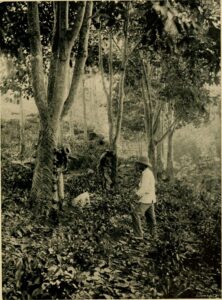
Natural rubber extraction in the heyday of colonialism
At first, tyres were made from natural rubber taken from Hevea brasiliensis, the tropical rubber tree.
The first car with pneumatic tyres was designed by Édouard Michelin in 1895. Making them was already a major source of pollution, because of the vulcanisation process invented in the 19th century. (François Jarrige and Thomas Le Roux, The Contamination of the Earth: A History of Pollutions in the Industrial Age, MIT Press, 2020; French original: La Contamination du monde, 2017, chapter 9, pp. 247–248)
In the early 20th century, butyl was adopted for inner tubes and inner tyre liners. It is a synthetic elastomer ten times more airtight than natural rubber. Chlorine was added to it to help it bond chemically with the rubber. Production became industrial in the 1930s, when DuPont invented neoprene, based on polychloroprene, the first true synthetic rubber.
After the war, tyre composition diversified. To make tyres more durable, manufacturers added sulphur, oils and carbon black, a highly toxic substance, as well as various braided metals (zinc, cadmium). Besides the pollution caused by manufacturing composite rubber, daily wear from road friction was considered for the first time. The release of fine particles probably became as dangerous as that from fuels. Globally, these microscopic residues have massively contaminated the oceans.

Neoprene became a pop-culture myth after actress Claudine Auger, a former Miss France, wore a skin-tight synthetic diving suit in Thunderball (1965), the fourth James Bond film.
Finally, tyres became the archetype of waste that baffled waste management systems. In the early 1970s, mountains of millions of tyres in landfills posed problems with no solution: they were hard to recycle, the volume was huge, and the smoke from incinerating them was very harmful. Incineration was initially quite common but was gradually regulated.
Then came official schemes to dump tyres at sea. In 1972, two million used tyres were sunk 2 km off the coast of Florida, near Fort Lauderdale. The justification was an ecological one: to create artificial reefs for marine life. Out of sight, out of mind. This invisible disposal of awkward toxic waste was copied in France, where 90,000 cubic metres of used tyres were sunk in the Mediterranean. Portugal, Spain and Italy followed suit. Japan claimed the world title by sinking 20 million cubic metres of tyres at sea. As usual with pollution, the cost of these operations was passed on to future generations.
The environmental damage was, predictably, considerable, and later generations had to pull the tyres out of the sea at enormous expense. The Fort Lauderdale tyre reefs (Osborne Reef) failed miserably: the tyres broke loose and destroyed the coral. Since 2007, the State of Florida and the US military have removed hundreds of thousands of tyres from the sea. This is just one of the costs passed on to future generations.
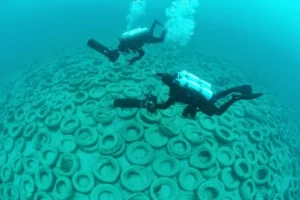
The tyre reefs off Fort Lauderdale (Osborne Reef), Florida, USA
Back to Constitution Square
There are no public air quality measurements from the event. We can still understand what happened, though, by looking at what drift cars do to their tyres and fuel.
An ordinary tyre wears so slowly that it lasts for years. When drifting, a tyre can be “melted” in just a few minutes. The rear wheels spin on the asphalt, heat up intensely, and the rubber turns into the thick cloud of smoke that spectators can see and smell. When dozens of cars do this for an entire weekend, the rubber lost in a few hours equals, many times over, the wear an ordinary car would produce in its entire lifetime. In normal driving, most of the rubber falls to the ground as coarser dust. When drifting, much of it goes straight into the air as fine smoke, right at the level where people breathe.
Drifts and donuts are very cool to watch, and drifting is a sport that reveals extraordinary driving talent. Even so, an event like this should not take place in the centre of a large city.
First, there is concentrated exposure. Thousands of spectators, including children, stand a few metres from the source, exactly where the smoke is densest. There is no safe exposure threshold for ultrafine particles and PAHs (polycyclic aromatic hydrocarbons). Second, dispersion is poor. Constitution Square is surrounded by tall buildings and opens onto the “urban canyon” of Unirii Boulevard. Air circulates poorly, and in October temperature inversions are frequent and keep pollutants close to the ground.
We repeat ad nauseam that Bucharest is already an over-polluted city. Since 2020 we have been in infringement over air quality in the capital; it has become a cliché. The new EU Ambient Air Quality Directive (2024/2881), however, will impose even stricter limits from 2030. An event that deliberately adds particles to the centre of the capital contradicts these obligations. The layer of rubber left on the asphalt after the event is washed by rain into the sewers and ends up in the Dâmbovița river, carrying zinc, 6PPD-quinone and microplastics with it.
This event normalises the very behaviour that Euro 7 and UNECE are trying to curb.
Low Emission Zone à la roumaine
To head off accusations of green wokeism, I’ll say it again as moderately as I can. Drifting is a legal sport and, for many, a very cool one. The natural solution is to hold it on circuits or purpose-built grounds outside densely populated areas, with the public kept at a reasonable distance from the track. For no other reason than this: all of Bucharest is going to be a Low Emission Zone, isn’t it?


